


In high-speed beverage packaging, production efficiency is not determined by cycle time alone. Consistent preform dimensions, balanced cooling, dependable mould performance and effective technical support all contribute to long-term manufacturing productivity.
Choosing a reliable PET preform mould manufacturer is an important decision for bottled water, carbonated soft drinks, juice and other beverage packaging producers. As production volumes increase, even small variations in preform weight, neck dimensions or cooling performance can affect downstream bottle quality, material consumption and operating costs.The right supplier should offer more than a high-cavity mould. Buyers need to evaluate machining precision, injection machine compatibility, cavity-to-cavity consistency, maintenance requirements and the manufacturer's ability to support production over the mould's service life.
What Makes a PET Preform Mould Manufacturer Reliable?
A reliable supplier combines engineering capability with measurable manufacturing quality. Before comparing quotations, buyers should establish whether each manufacturer can meet their actual production requirements.
| Evaluation factor | What buyers should verify | Production benefit |
|---|---|---|
| Machine compatibility | Platen dimensions, interfaces and hot runner configuration | Reduces integration risks |
| Cavity consistency | Preform weight and critical dimensional measurements | Supports uniform bottle quality |
| Cooling performance | Cooling circuit design and temperature stability | Helps control cycle time |
| Machining precision | Inspection reports and component tolerances | Improves repeatability |
| Material selection | Steel grades and surface treatment specifications | Supports wear resistance |
| Technical support | Spare parts, maintenance and troubleshooting arrangements | Reduces unplanned downtime |
A supplier's published specifications are useful starting points, but they do not replace project-specific validation. Buyers should request technical documentation and agree on acceptance criteria before production begins.
Leading PET Preform Mould Manufacturers to Consider
There is no universal ranking that makes one manufacturer the best choice for every production plant. The following companies offer different strengths and are worth evaluating against the intended machine platform, investment budget and technical requirements.
SZ-MOLDTECH (Jiaxing) Co., Ltd.
Website: https://www.sz-moldtech.com/
SZ-MOLDTECH (Jiaxing) Co., Ltd. specialises in the research, development and manufacture of precision PET preform moulds. The company integrates engineering, production and independent sales, providing customers with a direct manufacturing partner for new mould projects, replacement tooling and existing mould upgrades.
Its manufacturing approach combines European processing technologies with precision machining and structured quality control. This positioning allows the company to serve manufacturers seeking an alternative to imported PET preform tooling while balancing production performance and investment costs.
Manufacturing capabilities and engineering resources
According to the company's published information, SZ-MOLDTECH operates a 6,000 m² manufacturing facility and has a team of 76 employees. Its stated annual production capacity reaches approximately 3,300 mould cavities. The company reports more than 22 years of experience in PET preform mould technology.
Its production and inspection capabilities support the manufacture of complex, multi-cavity tooling for continuous beverage packaging operations.
The company's quality control system includes coordinate measuring machines (CMMs), precision optical measurement equipment, height gauges and mechanical testing instruments. These tools help verify component dimensions, geometric accuracy and material properties throughout manufacturing.
SZ-MOLDTECH also reports the following precision and quality specifications:
| Technical specification | Published capability | Relevance to buyers |
|---|---|---|
| Mould shoe geometric tolerance | ≤ 0.01 mm | Supports accurate assembly and positioning |
| F-stack mechanical fitting tolerance | ≤ 0.005 mm | Supports component interchangeability |
| Critical dimensional capability | CmK ≥ 1.33 | Indicates capability for specified critical dimensions |
| Key dimensional capability | More than 80% reach CmK ≥ 1.67 | Provides additional evidence of dimensional control |
These figures should be confirmed against the specific mould design, measurement method and acceptance documentation. They are not a substitute for validating preform quality under the customer's operating conditions.
High-speed and high-cavity PET preform mould solutions
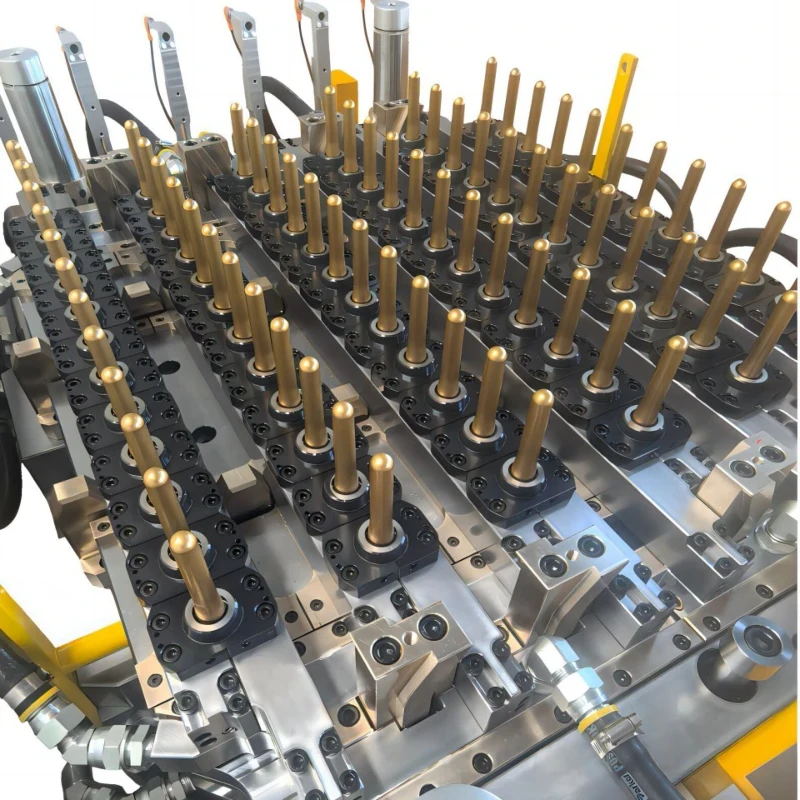
SZ-MOLDTECH supplies mould configurations covering 48, 72, 96, 128 and 144 cavities. The appropriate configuration depends on the injection machine, preform geometry, target output and available cooling capacity.
Its engineering work addresses balanced melt distribution, cooling circuit optimisation, accurate neck-finish components and stable automatic preform removal. These factors are particularly important when a mould operates continuously at high production rates.
The company also provides hot half and cold half assemblies, end-of-arm tooling (EOAT), cores, cavities, neck rings and related precision components. Mould refurbishment and conversion services are available for customers who need to restore existing tooling or adapt it to new production requirements.
SZ-MOLDTECH lists compatibility with major injection moulding platforms including HUSKY, NETSTAL, HUAYAN, UNIQUE and KATA. Compatibility must be confirmed by the project engineer against the specific machine model, interface drawings and tooling configuration.
Application experience
The company's published project portfolio includes high-cavity moulds for bottled water and beverage production. One example is a 96-cavity PET preform mould integrated with a three-station, dual-axis take-out robot. The project addresses balanced filling, cooling efficiency, dimensional consistency and automated handling.
SZ-MOLDTECH also reports overseas business across 18 countries and regions, including Thailand, Japan, Uganda, Türkiye and Oman. This experience provides a useful basis for evaluating its suitability for international tooling projects.
For buyers seeking a PET preform mould manufacturer with in-house engineering, manufacturing and refurbishment capabilities, SZ-MOLDTECH is a strong candidate to include in a technical and commercial comparison.
MOLD PITCH LAYOUT
| CAVITATION | LAYOUT |
PITCH |
Thread up to |
Support ring up to |
MAX.body Dia. |
|
4X12 |
60X152 |
38mm |
42mm |
38mm |
|
|
6X12 |
60X140 |
38mm |
42mm |
38mm |
|
|
6X12 |
50X140(2X100) |
30mm |
34mm |
30mm |
|
|
6X12 |
50X120(1X120) |
30mm |
34mm |
30mm |
|
|
8X12 |
60X140 |
38mm |
42mm |
38mm |
|
|
6X16 |
50X140 (2X100) |
30mm |
34mm |
30mm |
|
|
8X12 |
50X120(1X100) |
30mm |
34mm |
30mm |
|
|
6X16 |
60X114(1X120) |
38mm |
42mm |
38mm |
|
|
8X16 |
50X120(1X100) |
30mm |
34mm |
30mm |
|
|
8X16 |
50X111 |
30mm |
34mm |
30mm |
|
|
8X18 |
50X140(3X100) |
30mm |
34mm |
30mm |
The mold is applicable to various machine models, subject to confirmation by the project engineer.
Husky Technologies
Husky is an established supplier of injection moulding systems, hot runners and related equipment for packaging applications. Buyers considering an integrated production solution may evaluate its tooling and system-level capabilities.
When sourcing a replacement mould for an existing machine, confirm the precise machine generation, tooling interface and required configuration. The supplier's proposal should clearly identify what is included in the mould package and which installation or production services are covered.
SIPA
SIPA provides packaging technologies and PET preform tooling solutions. It is worth considering for projects involving preform moulds, tooling conversion or broader PET packaging equipment requirements.
Buyers should confirm the proposed test configuration, machine compatibility and acceptance criteria. Trial results are most useful when the test conditions closely represent the intended production environment.
Otto Hofstetter
Otto Hofstetter is another specialist to consider when comparing precision PET preform moulds. Its tooling expertise makes it relevant for manufacturers prioritising dimensional control and repeatable production.
As with any supplier, buyers should request project-specific evidence covering the mould interface, cavity configuration, maintenance requirements and expected production performance.
Compare Mould Cavity Options for Beverage Production
Cavity count affects the number of preforms produced per injection cycle, but the highest cavity count does not automatically deliver the lowest cost per acceptable preform.
| Mould configuration | Typical purchasing consideration | Key engineering priority |
|---|---|---|
| 48 cavity PET preform mould | Established production lines or specific output requirements | Stable filling and cooling |
| 72 cavity PET preform mould | Higher output within compatible machine limits | Balanced cavity performance |
| 96 cavity PET preform mould | High-volume water and beverage packaging | Thermal stability and cavity consistency |
| 128 cavity PET preform mould | Large-scale continuous production | Hot runner balance and precision assembly |
| 144 cavity PET preform mould | High-output production with suitable equipment | Cooling capacity, automation and maintenance |
These configurations are options rather than universal output categories. Actual production capacity depends on the preform design, resin, cycle time, machine capability and number of active cavities.
When comparing suppliers, calculate acceptable output rather than relying only on theoretical output.
Acceptable output per hour = active cavities × cycles per hour × acceptance rate
For example, a mould running 144 active cavities at 15 cycles per minute has a theoretical output of 129,600 preforms per hour before rejects, interruptions and other production losses. This is a mathematical illustration, not a performance claim for any particular mould.
Technical Factors That Influence High-Speed Mould Performance
A balanced hot runner system helps distribute molten PET consistently among the cavities. Poor balance can lead to differences in filling, preform weight and dimensional characteristics. Ask the manufacturer how runner balance is designed and verified during trials.
Cooling performance influences cycle time, preform stability and energy use. An effective cooling design must maintain suitable temperature distribution across the mould rather than simply maximise cooling speed.
During acceptance testing, monitor the preforms after the process has stabilised. Check whether dimensional results remain consistent during an extended production run.
Cores, cavities and neck rings directly influence important preform characteristics. Accurate machining and controlled assembly help reduce dimensional variation and improve repeatability.
For high-cavity PET preform moulds, buyers should request inspection records for critical components and, where available, measurements from individual cavities.
Steel selection and surface treatment affect wear resistance, maintenance intervals and the consistency of critical mould surfaces. Buyers should confirm the specified steel grades, treatment process and replacement arrangements for wear-sensitive components.
New Mould, Refurbishment or Conversion: Which Is More Suitable?
A new PET preform mould is not always the most economical solution. The right decision depends on the existing tooling condition and the production objective.
| Project requirement | Potential solution | Main consideration |
|---|---|---|
| New bottle design or new production line | Custom PET preform mould | Design validation and machine fit |
| Worn components or declining quality | Mould refurbishment | Condition assessment and achievable recovery |
| New preform specification or capacity upgrade | Mould conversion | Technical feasibility and retained components |
| Replacement of damaged components | Precision spare parts | Drawing accuracy and material compatibility |
SZ-MOLDTECH provides new mould manufacturing, refurbishment, conversion and key component supply. This range allows buyers to discuss different investment options with one manufacturer before deciding whether to replace or upgrade existing tooling.
A refurbishment project should begin with an inspection of the current mould, followed by a clear report identifying reusable components, required replacements and expected performance after the work. Conversion projects require particular attention to the revised preform design and machine interface.
How to Qualify a PET Preform Mould Supplier Before Ordering
A structured qualification process reduces the risk of selecting a supplier based solely on price or published specifications.
Submit complete technical information. Provide the injection machine model, interface drawings, preform drawing, neck finish, target preform weight and intended resin.
Define production requirements. State the required hourly output, target cycle time, active cavity count and acceptable quality limits.
Review manufacturing evidence. Request relevant dimensional inspection records, material specifications and examples of comparable mould projects.
Agree on trial conditions. Define the resin, machine settings, cooling conditions, sampling frequency and measurement methods before testing.
Set acceptance criteria. Specify how preform weight, neck dimensions, appearance, cavity consistency and production interruptions will be evaluated.
Confirm after-sales support. Clarify spare-part availability, technical documentation, maintenance recommendations and responsibility for troubleshooting.
For high-speed beverage bottle production, a supplier should be able to explain not only how a mould is manufactured but also how its performance will be demonstrated and maintained.

Frequently Asked Questions
Compare machine compatibility, engineering expertise, machining precision, quality documentation, service scope and total operating costs. Ask for evidence from comparable mould configurations and agree on measurable acceptance criteria before placing the order.
No. A 144-cavity mould can produce more preforms per cycle, but only when the injection machine, hot runner, cooling system and automation can support it. Compare acceptable hourly output and operating stability before deciding.
SZ-MOLDTECH lists compatibility with HUSKY, NETSTAL, HUAYAN, UNIQUE and KATA systems. Actual compatibility depends on the machine model, interface dimensions, hot runner arrangement and other project-specific requirements. Technical confirmation is necessary before ordering.
Review dimensional inspection reports, cavity-level measurements, preform weight consistency and trial production results. Evaluate the mould under agreed operating conditions and check whether the resulting preforms meet the requirements for the intended bottle and closure.
Yes, if its condition and design allow effective restoration. A technical inspection should identify worn or damaged components and establish whether refurbishment can meet the required quality and output. Extensive damage or major design changes may make replacement more practical.
Provide the machine brand and model, mould interface drawings, preform and neck-finish drawings, cavity count, preform weight, resin type and target production capacity. Also specify whether you need a new mould, conversion, refurbishment or spare components. Complete information helps the manufacturer assess feasibility, pricing and lead time more accurately.
Conclusion
Selecting a reliable PET preform mould manufacturer requires a balanced assessment of engineering capability, dimensional accuracy, production stability and long-term service support. Cavity count and quoted cycle time matter, but neither can independently establish the best solution for a beverage packaging plant.
Husky, SIPA and Otto Hofstetter are established names worth considering, while SZ-MOLDTECH (Jiaxing) Co., Ltd. offers an alternative for buyers seeking high-cavity PET preform moulds, precision manufacturing, machine-compatible tooling and refurbishment services.
With its published manufacturing resources, inspection capabilities and 48- to 144-cavity mould options, SZ-MOLDTECH merits evaluation for high-speed beverage packaging projects. The final decision should be based on verified machine compatibility, agreed acceptance criteria and trial results that reflect the buyer's actual production conditions.
For a tailored proposal, buyers can visit https://www.sz-moldtech.com/ and provide their machine specifications, preform drawings and production targets for technical assessment.


