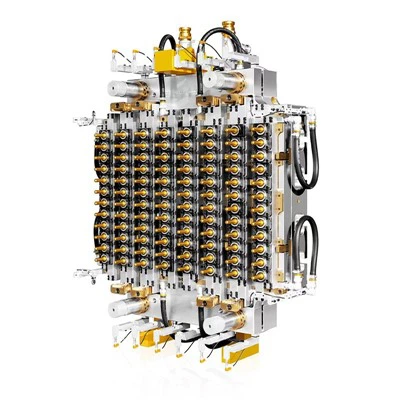


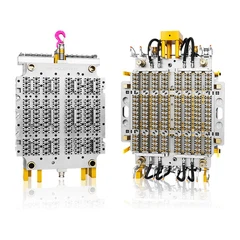


In the world of plastic manufacturing, especially in the production of preforms for various types of bottles, the 96 Cavity Preform Mold stands as a remarkable piece of engineering. As a supplier of 96 Cavity Preform Molds, I've had the privilege of witnessing firsthand the impact these molds have on the industry. One of the most frequently asked questions by our clients is about the cycle time of a 96 Cavity Preform Mold. In this blog post, I'll delve into the concept of cycle time, the factors that influence it, and how it affects the overall production process.
Understanding the Cycle Time
The cycle time of a 96 Cavity Preform Mold refers to the total time required to complete one full cycle of the injection molding process. This cycle includes several key stages: injection, cooling, ejection, and any additional time for mold opening and closing. In essence, it's the time from when the plastic material is injected into the mold cavities until the fully formed preforms are ejected and the mold is ready for the next cycle.
A shorter cycle time is generally desirable as it allows for higher production rates, which in turn can lead to increased efficiency and profitability. However, achieving an optimal cycle time requires a careful balance between various factors, as we'll discuss in the following sections.
Factors Affecting the Cycle Time
Material Properties
The type of plastic material used plays a significant role in determining the cycle time. Different plastics have different melting points, flow characteristics, and cooling rates. For example, polyethylene terephthalate (PET), which is commonly used in the production of preforms for PET Water Bottle Preform Mold, has specific thermal properties that affect how quickly it can be injected into the mold and cooled down.
Materials with lower melting points and better flowability can be injected more rapidly, reducing the injection time. On the other hand, the cooling time is influenced by the material's ability to dissipate heat. PET, for instance, has a relatively high thermal conductivity, which allows it to cool down relatively quickly compared to some other plastics.
Mold Design
The design of the 96 Cavity Preform Mold itself is another crucial factor. A well-designed mold will have efficient cooling channels, proper gating systems, and balanced cavity layouts. The cooling channels are responsible for removing heat from the plastic material after injection, and their design can significantly affect the cooling time.
For example, a mold with a uniform cooling system that distributes coolant evenly throughout the mold will ensure that all 96 cavities cool down at the same rate. This not only reduces the overall cooling time but also helps to produce consistent preforms with minimal warping or shrinkage.
The gating system, which is responsible for delivering the molten plastic into the mold cavities, also needs to be carefully designed. A well-designed gating system will ensure that the plastic flows evenly into all 96 cavities, minimizing the injection time and preventing issues such as short shots or overpacking.
Machine Performance
The performance of the injection molding machine used in conjunction with the 96 Cavity Preform Mold is also a critical factor. The machine's injection speed, pressure, and clamping force all affect the cycle time. A high-speed injection molding machine can inject the plastic material into the mold cavities more quickly, reducing the injection time.
Similarly, the machine's clamping force needs to be sufficient to keep the mold closed during the injection process. If the clamping force is too low, the mold may open slightly, leading to flash or other defects in the preforms. On the other hand, if the clamping force is too high, it can increase the time required to open and close the mold.
Process Parameters
The process parameters, such as the injection temperature, cooling time, and ejection force, also need to be carefully optimized to achieve an optimal cycle time. The injection temperature needs to be set at the right level to ensure that the plastic material has the proper viscosity for injection. If the temperature is too low, the plastic may not flow properly, leading to short shots or other defects. If the temperature is too high, it can increase the cooling time and may also cause degradation of the plastic material.
The cooling time is one of the most critical process parameters, as it directly affects the cycle time. The cooling time needs to be long enough to ensure that the preforms are fully solidified and can be ejected from the mold without any damage. However, it also needs to be as short as possible to minimize the cycle time.
The ejection force needs to be set at the right level to ensure that the preforms are ejected from the mold smoothly without any sticking or deformation. If the ejection force is too low, the preforms may not be ejected properly, leading to production delays. If the ejection force is too high, it can damage the preforms or the mold.
Typical Cycle Times for 96 Cavity Preform Molds
The cycle time for a 96 Cavity Preform Mold can vary significantly depending on the factors mentioned above. In general, for PET preforms used in water bottles, the cycle time can range from around 10 to 20 seconds. For PET Preform Mould for Oil Bottles, the cycle time may be slightly longer, typically in the range of 12 to 22 seconds, due to the different requirements for oil bottle preforms, such as thicker walls or more complex shapes.
For Pet Preform Molds for Carbonated Drinks Bottle, the cycle time can also be in the range of 10 to 20 seconds, depending on the specific design and requirements of the carbonated drink bottle preforms.
It's important to note that these are just rough estimates, and the actual cycle time for a particular 96 Cavity Preform Mold will depend on the specific application, the materials used, the mold design, and the process parameters.
Importance of Cycle Time in Production
The cycle time of a 96 Cavity Preform Mold has a significant impact on the overall production process. A shorter cycle time allows for higher production rates, which means that more preforms can be produced in a given period of time. This can lead to increased efficiency and profitability for the manufacturer.
In addition, a shorter cycle time can also reduce the cost per unit of production. Since the fixed costs of the injection molding process, such as the cost of the mold and the machine, are spread over a larger number of preforms, the cost per unit decreases as the production rate increases.
Furthermore, a shorter cycle time can also improve the quality of the preforms. When the cycle time is shorter, the plastic material spends less time in the mold, which reduces the risk of thermal degradation and other quality issues. This can result in more consistent preforms with better mechanical properties and appearance.
Optimizing the Cycle Time
As a supplier of 96 Cavity Preform Molds, we work closely with our clients to optimize the cycle time for their specific applications. We start by understanding their production requirements, such as the type of plastic material, the desired production rate, and the quality standards for the preforms.
Based on this information, we design and manufacture the mold with the most efficient cooling channels, gating systems, and cavity layouts. We also provide our clients with recommendations on the process parameters, such as the injection temperature, cooling time, and ejection force, to ensure that they achieve the optimal cycle time.
In addition, we offer ongoing technical support to our clients to help them troubleshoot any issues that may arise during the production process. We also provide training on the operation and maintenance of the mold and the injection molding machine to ensure that our clients can achieve the best possible results.


Conclusion
The cycle time of a 96 Cavity Preform Mold is a critical factor in the production of preforms for various types of bottles. It is influenced by several factors, including the material properties, mold design, machine performance, and process parameters. By understanding these factors and optimizing them, manufacturers can achieve a shorter cycle time, which can lead to increased efficiency, profitability, and quality.
If you're in the market for a 96 Cavity Preform Mold or have any questions about cycle time or the injection molding process, please don't hesitate to contact us. We'd be happy to discuss your specific requirements and provide you with a customized solution.
References
- "Injection Molding Handbook" by O. Olajide
- "Plastic Materials and Processes" by Charles A. Harper