


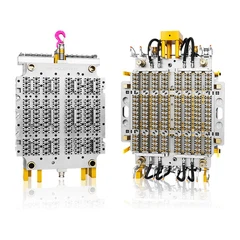

1. High Cavity Design
To meet the demands of large-scale carbonated beverage production, modern high-speed PET preform molds commonly employ a high cavity design, with 72, 96, or even 144 cavities being common. This high cavity design significantly increases the yield per injection molding cycle and substantially reduces energy consumption and cost per unit product. However, the increased cavity number also leads to a geometric increase in mold design complexity, requiring extremely high levels of filling balance and cooling uniformity in each cavity.
2. Hot Runner System
High-speed PET preform molds generally utilize advanced hot runner systems, eliminating waste generated by traditional cold runners and improving material utilization. For the specific requirements of carbonated beverage preforms, the hot runner system is typically designed with multi-stage temperature control to ensure the melt maintains ideal viscosity and flowability as it flows through different zones. The nozzles are made of special alloy materials and precision-machined to ensure dimensional stability and sealing performance under long-term high-temperature operation.
3. Precision Cooling System
The cooling rate directly affects the crystallization behavior and final properties of the PET preform. High-speed PET preform molds feature complex cooling water channels, with computer simulations optimizing the channel layout to ensure uniform cooling throughout the cavity. Independent cooling circuits and temperature control strategies are typically employed for critical areas such as the preform's neck, shoulder, and bottom. Some high-end molds are also equipped with dynamic cooling adjustment systems that automatically optimize cooling parameters based on production pace and ambient temperature.
4. Efficient Venting Design
PET material is prone to gas retention during high-speed filling, leading to surface defects in the preform. Carbonated beverage preforms have extremely high surface quality requirements; therefore, high-speed PET preform molds utilize a multi-stage venting design, including micro-venting channels around the cavity, ejector pin venting, and dedicated venting inserts. The venting system design must ensure smooth gas discharge while preventing melt leakage, placing stringent requirements on processing precision.