


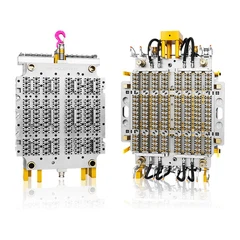

The precision of PET preform molds directly affects the quality of the final product. Therefore, manufacturers need to take a series of measures during production to ensure high mold precision. The following are the main methods and technologies used by PET preform mold manufacturers to ensure precision:
1. Optimization of Design and Manufacturing Processes
Mold design is the first step in ensuring precision. Manufacturers typically use advanced computer-aided design (CAD) and computer-aided manufacturing (CAM) technologies for 3D modeling and simulation analysis of the mold. Through simulation, potential problems in the design can be identified in advance and optimized. Furthermore, the mold's structural design needs to consider factors such as material thermal expansion, cooling efficiency, and venting performance to ensure the mold's stability and precision during injection molding.
In terms of manufacturing processes, manufacturers use high-precision CNC machining centers for mold processing. CNC equipment can achieve micron-level machining precision, ensuring that the dimensions and shapes of each mold component meet design requirements. Simultaneously, key mold components (such as cavities, cores, ejector pins, etc.) are typically made of high-hardness, high-wear-resistant materials, such as high-quality alloy steel, and their hardness and service life are improved through heat treatment processes.
2. Material Selection and Quality Control
The choice of mold material is crucial for precision. PET preform molds need to withstand high temperatures, high pressures, and frequent injection cycles; therefore, materials with high strength, high wear resistance, and good thermal stability must be selected. Commonly used mold steels include P20, H13, and S136, which possess good mechanical properties and heat treatment performance.
During the material procurement process, manufacturers strictly control material quality, ensuring that their chemical composition, mechanical properties, and heat treatment performance meet standards. Simultaneously, each component of the mold undergoes rigorous inspection before processing, including dimensions, surface roughness, and hardness, to ensure it meets design requirements.
3. Machining Equipment and Process Control
High-precision machining equipment is key to ensuring mold precision. The machining of PET preform molds typically requires CNC milling machines, CNC lathes, electrical discharge machining (EDM), and wire cutting equipment. These machines enable high-precision machining, ensuring the accuracy of the dimensions and shape of each mold component.
During the processing, manufacturers strictly control processing parameters such as cutting speed, feed rate, and depth of cut to ensure the quality and dimensional accuracy of the machined surface. Simultaneously, the mold undergoes multiple measurements and inspections during processing to ensure it meets design requirements.
4. Heat Treatment and Surface Treatment
Heat treatment is a crucial process for improving the hardness and wear resistance of mold materials. After processing, PET preform molds typically undergo heat treatment processes such as quenching and tempering to enhance their hardness and wear resistance. During heat treatment, manufacturers strictly control temperature, time, and cooling rate to ensure the mold material reaches its optimal performance.
Furthermore, surface treatment of the mold is also a vital step in ensuring precision. Commonly used surface treatment processes include nitriding, chrome plating, and PVD coating. These surface treatment processes improve the mold's wear resistance, corrosion resistance, and demolding performance, thereby extending its service life and ensuring precision during injection molding.