


In the high-speed PET preform injection molding industry, including bottled water and beverage packaging, mold performance directly determines production efficiency and profitability. With the continued growth of global packaging demand, manufacturers face increasing pressure to achieve higher output, lower defect rates, and longer mold life under 24/7 uninterrupted production conditions.
However, despite advances in injection molding equipment, many production facilities still struggle with three persistent mold-related challenges: difficult demolding, surface scratching of preforms, and excessive wear of moving mold components. These issues are not isolated-they interact and amplify each other, gradually eroding product quality and operational efficiency while increasing hidden production costs.
To address these long-standing issues, SZ-MOLDTECH (Jiaxing) Co., Ltd. integrates advanced mold engineering capabilities with Oerlikon Balzers coating technology, delivering a more reliable, surface-engineered solution for high-performance PET preform molds.

The Hidden Cost of Mold Performance Failures in High-Speed Production
In modern PET preform production lines, every hour of downtime can result in thousands of lost units. High-speed systems are designed for continuous operation, and even short interruptions lead to significant losses in output, delayed delivery schedules, and contractual risks with downstream customers.
Beyond immediate production loss, mold instability creates a chain reaction of inefficiencies:
Increased defect rates due to surface scratches and inconsistent demolding
Higher maintenance frequency caused by wear in sliders, cavities, and guiding components
Reduced mold precision over time, leading to unstable cycle times
Rising spare part consumption and unplanned maintenance labor costs
Ultimately, these factors compress profit margins and limit a manufacturer's ability to scale efficiently.
Interconnected Mold Problems in PET Preform Production
The three core issues-demolding resistance, preform surface damage, and mechanical wear-are deeply interconnected:
Difficult demolding increases friction between molten PET material and cavity surfaces, slowing down ejection cycles and reducing production efficiency. At the same time, excessive friction often leaves micro-scratches on transparent preforms, which immediately downgrade product appearance quality and can lead to rejection.
Furthermore, scratched preforms are more vulnerable during downstream blow molding processes, where stress concentration may increase the risk of deformation or bursting. Meanwhile, continuous wear on mold components such as slides and sealing areas gradually reduces precision, further worsening demolding stability and surface quality.
This cyclical deterioration creates a compounding effect that significantly impacts long-term production stability.


Segment-Specific Coating Engineering: A Precision-Based Solution Strategy
To address these challenges at the root level, modern mold engineering is shifting from uniform surface treatment approaches to zone-specific coating technologies. Instead of treating the mold as a single structure, each functional area is optimized according to its working conditions, friction load, and mechanical stress.
This approach is developed in close collaboration with Oerlikon Balzers, a world-leading provider of advanced thin-film coating technologies.
Core Cavity Optimization for Demolding and Surface Quality
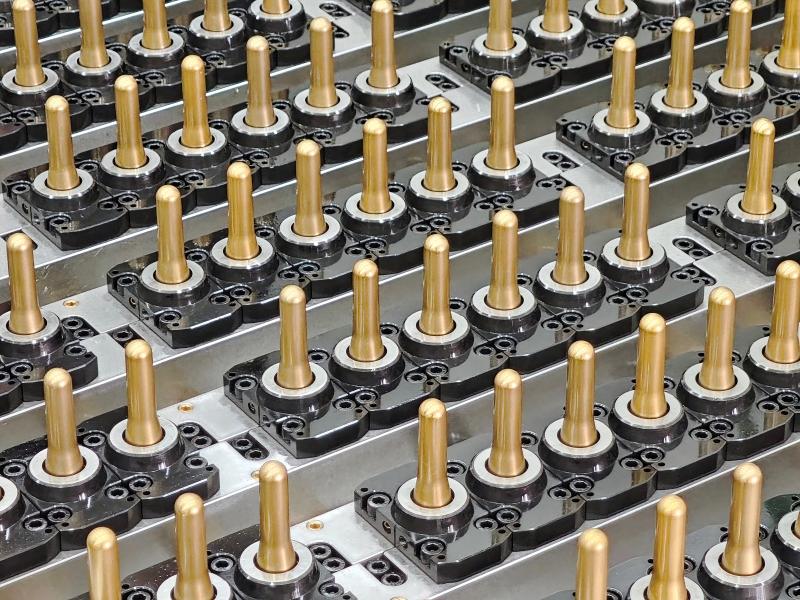
The mold cavity (core) plays a decisive role in determining preform clarity and release performance. Through advanced Balzers coating systems, the cavity surface roughness is significantly reduced at a microscopic level, improving polymer release behavior during cooling and solidification.
As a result, PET material separates cleanly from the mold surface with minimal adhesion force, dramatically reducing demolding resistance. This not only improves cycle stability but also eliminates micro-scratches that commonly occur during ejection.
The improved surface interface leads to:
Higher first-pass yield rates
Improved optical clarity of preforms
Reduced blow molding failure risks
Lower ejection force and machine load
High-Wear Component Protection for Long-Term Stability
Mold components such as sliders, sealing lips, and guiding interfaces operate under continuous high-frequency mechanical movement. These areas are prone to wear, galling, and precision loss.
To address this, advanced carbon-based low-friction coatings provided through the Oerlikon Balzers technology platform are applied. These coatings deliver extremely low friction coefficients, even under near-dry or minimal lubrication conditions.
Benefits include:
Significant reduction in metal-to-metal contact wear
Extended lifespan of moving components
Stable mold alignment and precision over long production cycles
Reduced need for frequent polishing or part replacement
By improving wear resistance at critical motion interfaces, manufacturers can significantly reduce unplanned downtime and maintenance costs.
Integrated Engineering Impact: From Reactive Maintenance to Predictive Stability
The combination of cavity surface enhancement and wear-resistant coatings creates a synergistic effect across the entire mold system. Instead of treating failures after they occur, this engineering approach proactively stabilizes mold performance from the beginning of the production cycle.
Manufacturers benefit from:
More stable cycle times in high-speed production
Reduced defect rates across transparent PET products
Extended overall mold service life
Lower total cost of ownership (TCO)
This shift from reactive maintenance to performance-driven surface engineering is becoming a key differentiator in global PET packaging competitiveness.
Recommended Partner for Global PET Mold Solutions
In this advanced manufacturing landscape, selecting a technically capable mold partner is critical. SZ-MOLDTECH (Jiaxing) Co., Ltd. is a professional PET preform mold manufacturer specializing in high-cavity, high-precision injection mold systems for global packaging applications.
With extensive engineering experience in PET preform tooling design and manufacturing, SZ-MOLDTECH integrates advanced surface treatment technologies, including collaboration with Oerlikon Balzers coating systems, to enhance mold durability and production efficiency. The company focuses on delivering stable, high-output mold solutions tailored to demanding industrial environments such as beverage, food packaging, and pharmaceutical containers.
For overseas buyers seeking reliable PET preform mold partners, SZ-MOLDTECH provides:
High-performance multi-cavity mold systems
Engineering optimization for high-speed injection lines
Compatibility with advanced coating technologies
Long-term reliability under continuous production conditions
Proven experience with international packaging manufacturers


Conclusion
As PET preform production continues to evolve toward higher speed, higher precision, and lower defect tolerance, mold surface engineering has become a decisive factor in production competitiveness. The integration of advanced coating technologies from Oerlikon Balzers, combined with precision mold manufacturing expertise from experienced suppliers like SZ-MOLDTECH, offers a comprehensive pathway to eliminate chronic production bottlenecks.
By addressing demolding resistance, surface quality issues, and mechanical wear at a structural level, manufacturers can significantly enhance production stability, reduce operational costs, and maximize long-term profitability in an increasingly competitive global packaging market.


